Posts

Showing posts with the label analysis

Data, analytics and AI in 2018: Some hopes and pointers

When pondering what to write about looking forward to 2018 I had a shortlist of three hot topics: AR Blockchain Artificial Intelligence (AI) I didn't choose AR as I think it will remain a specialist tool, although cool apps like  Star Chart  that my family love exist and Pokemon Go showed how addictive usage in games can be, it's still early days for tool kits like ARKit  to make a break through app. Blockchain is still probably at least a year off. Given the co-ordination needed in business process innovation it takes a bit longer to get into the mainstream. It appears that the processing speed is also a bit of a impediment at the moment. I am watching this field with interest though as it has potential to change the way companies process transactions. (Edit:  although this is now the subject of a 15below tech take ) Which leaves AI. I chose this not just because it's been my key interest my whole adult life, but also because it is making another bi...

R for Product Management

Image
Photo by  Štefan Štefančík  on  Unsplash Since my previous blog post I have made some progress on being able to replace most of what I currently use Excel for with R scripts. I have also launchjed a project to collect together some useful recipes for other Product Managers on GitHub called " R for Product Management " So far I have samples that cover the following data sources: Google Analytics - to my previous learning have added analysis of browsers used by site visitors and an example Shniy app for data exploration. InfluxDB - Working with time series data generated by the product, the two examples here are API response times and feature usage. This includes an example of manipulating time series data to set missing values to 0 for plotting. UptimeRobot - Simple example of taking error data and using a pivot table to explore the data, after some cleaning and filtering. This kind of workflow can be useful with large data sets. One thing th...

Building an onboarding process for a green field product

Image
This is  part of a series  about my side project  Bashfully , which aims to give graduates and other new entrants to careers a seasoned professional level way of expressing themselves through the super power of story telling. Following the core principles of being discoverable, personalised and guiding in approach. Photo by  Riku Lu  on  Unsplash Onboarding is an important part of B2C and pure "pay to play" SaaS. With so many tools to use, why would any user put effort into getting up and running? With B2B SaaS platforms that include professional services to get up and running then this isn't important. The same impact comes through the service that accompanies the product. I have been lucky to experience a great onboarding experience when evaluating product management software for work. The best by a country mile was ProdPad. This had two elements, the first was the trial and flow to get up and running. The second was the emails the accompanie...

BOOK REVIEW: Fifty quick ideas to improve your user stories by Gojko Adzic and David Evans

BOOK REVIEW: Fifty quick ideas to improve your user stories by Gojko Adzic and David Evans It has taken a while since my last book review to get the time to do much reading with moving. But here is my round up of "Fifty quick ideas to improve your user stories" by Gojko Adzic and David Evans Formats : Paperback, ePub, Mobi, PDF Where can I get it? From Leanpub , Amazon or any good bookshop.   Who is it for? Anyone involved in a software development project working in an iterative manner. As long as they understand some of the basics around user stories, e.g. they know what INVEST stands for. What's it about? As the title suggests "how to improve user stories", but it is a bit more than that. It covers the whole process including planning and iterative delivery activities. What's the book like? Each double page spread follows a similar style starting with an introduction to a new tip. Often illustrated with an anecdote fro...

On spikes and learning

Image
Photo by Sebastiaan ter Burg So having a good roadmap with themes it is now important to get the work delivered somehow. Unless the developers have done something similar enough before. You need some way of discovering how to chunk up the work. What you call this doesn't really matter, but I have used the agile term "spike".  According to a comment in the Agile dictionary , this is a rock climbing term. A spike is driven into the rock face to help support the climbers. Although it does not get us closer to the top it allows us to go faster and have a safer climb. Likewise, a development spike doesn't produce the feature faster, but it provides a foundation to move forwards. In a project kick-off meeting, I remarked about how successful the spike had been. A developer there joked that I should write a blog about it, so here it is... "challenge accepted". I have been reflecting on what I feel made the spike successful. This particular...

CONFERENCE: Travel Technology Initiative Summer Conference 2016 - Moneyfor nothing

Image
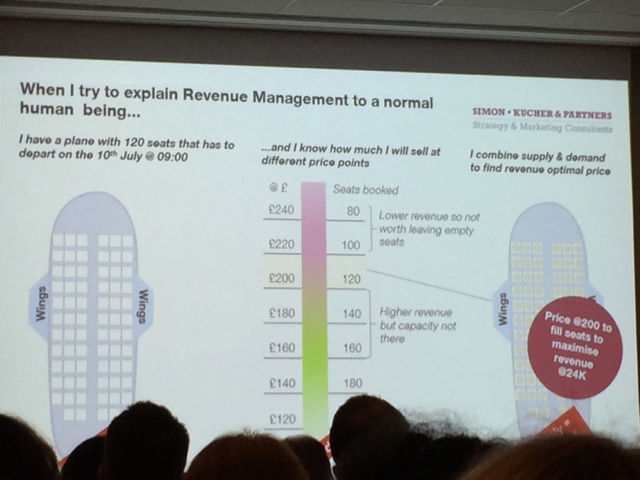
How to explain revenue mange ment to normal people... This year's TTI summer conference was around the idea of "money for nothing" - that is doing effective revenue management to get more profit without any extra product or inventory. Like most of the professions in and around travel, it should come as no surprise that data analytics and supporting business decisions effectively seemed to be the main theme of the morning.  There were three speakers covering various aspects. Deniz Dorbek from Wyndham Hotel Group started by talking about "Total revenue management" from a hotel point of view. This included exploiting spa, sports, food and beverage, meetings as well as room rates. A key point in her summary was around people in revenue management communicating and working closely with the marketing and online analytics teams to ensure success.  Dimitrios Hiotis from Simon-Kucher and Partners is from a tour operator background and introduced tools at TUI...

On AI and hype

Image
Machine Learning Miller by Bastian Greshake When I wrote about AI and the Future last year I was reasonably excited, as an Artificial Intelligence (AI) graduate, of the possibilities and jealous of those beginning their careers in AI. Since now they have the luxury of extreme computer power and storage, 3D printing and the other abundant pieces of technology needed to create the future bounded only by our imaginations! The past couple of months though and I am noticing a bit of a trend in conference presentations (and tweets coming out of conferences) that seem to have moved a lot of the hope and hype around big data onto AI. Or more specifically machine learning. I am not going to single out any specific examples, but I feel this covers two basic areas: I don't need to know about my data or structure it to get useful information and  I won't need to configure things. because machine learning. (Lack of ) Data structure I am not sure what i...

On HBX and online education

Image
I have written this blog post as a reflection on what has occupied me a lot in the past 3 months. After finishing my Post graduate Certificate in Technol ogy Manage ment with the O pen U niversity I was looking at what to do next in continuing my education - being a life long learner! I was looking at different online plat forms for interesting courses.  I was looking at sites like Coursera and  Future Learn , when I came across a new extension to Harvard Business School and a course they run called HBX CORe. This one paragraph pitch they provide sums it up pretty well: HBX CORe (Credential of Readiness) is a 120-150 hour certificate program on the fundamentals of business from Harvard Business School. CORe is comprised of three courses - Business Analytics, Economics for Managers, and Financial Accounting – developed by leading Harvard Business School faculty and delivered in an active learning environment based on the HBS signature case-based learning mod...